The Language of the World
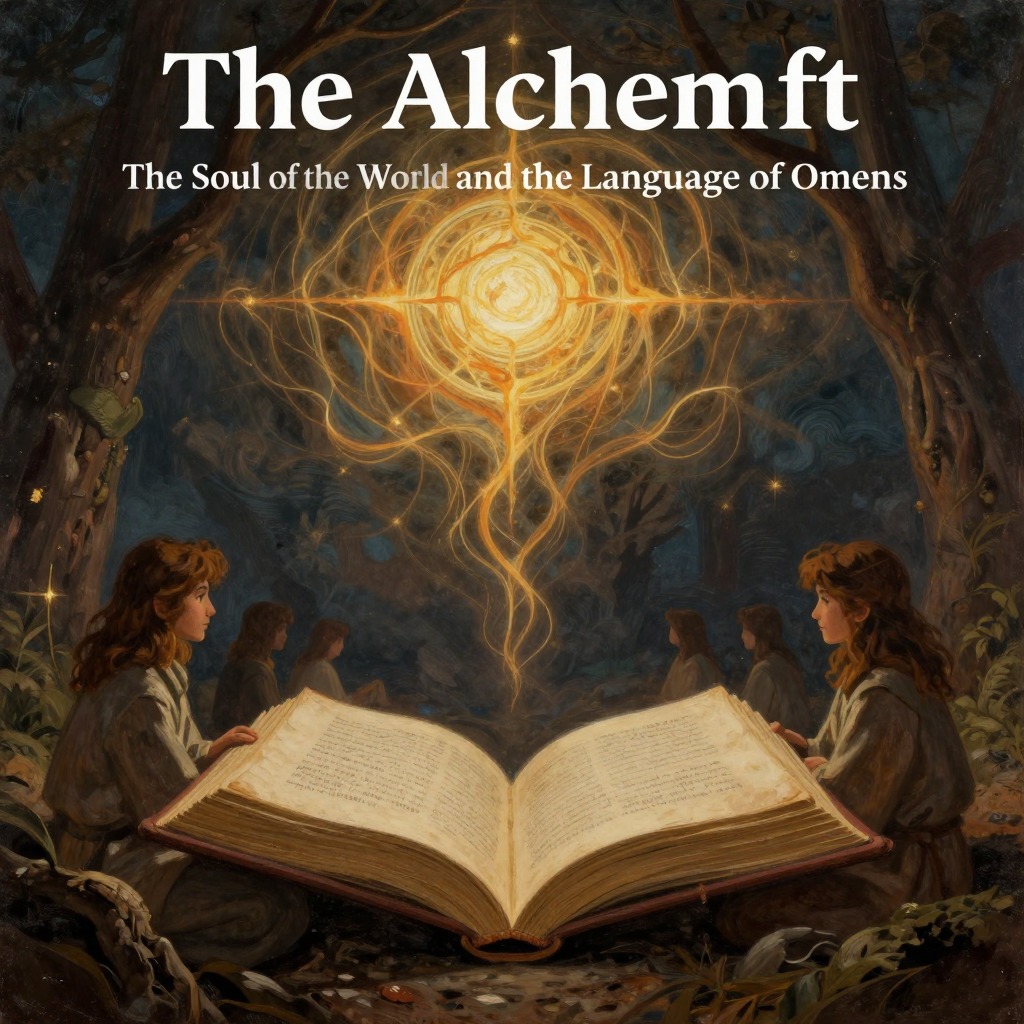
The Language of the World is the unifying, wordless tongue through which all of creation communicates, a concept that forms the philosophical core of Paulo Coelho's The Alchemist. It is the medium by which the Soul of the World expresses itself, and mastering it is essential for anyone pursuing their Personal Legend. The novel presents this language not as a system of grammar or vocabulary, but as an intuitive, universal understanding that transcends cultural and linguistic barriers, accessible to those who pay attention to omens and listen to their hearts.
Definition and Nature
The Language of the World is first introduced by the Englishman, who describes it as "a universal language, understood by everybody, but already forgotten" . He explains that it is written through the words "luck" and "coincidence" . Santiago comes to understand this language as one that "doesn't depend on words" , a realization that dawns on him when he observes an Arab and a Spaniard communicating perfectly despite speaking different languages. The novel emphasizes that this language is not intellectual but intuitive: it is the "language without words" that Santiago had already experienced with his sheep . The alchemist later clarifies that this language is accessed through action rather than study, telling Santiago, "There is only one way to learn... It's through action" . The Language of the World is thus presented as an innate, experiential knowledge that connects all things, from minerals to humans to the stars.
The Language of Omens and the Soul of the World
The Language of the World manifests most concretely through omens, which are the signs and patterns that the universe uses to guide those pursuing their destinies. Santiago learns to read these omens throughout his journey, from the flight of hawks to the behavior of his horse. The Englishman explains that this language is the means by which the Soul of the World communicates: "When you want something with all your heart, that's when you are closest to the Soul of the World" . The camel driver reinforces this, noting that any given thing on the face of the earth can reveal the history of all things, and that people can find a connection with their experience of the moment by observing what is occurring around them . The Language of the World is thus the bridge between the individual and the universal, allowing Santiago to perceive the Soul of the World and, ultimately, to understand that it is a part of the Soul of God .
Love as the Purest Expression
The novel identifies love as the most powerful and purest form of the Language of the World. When Santiago first meets Fatima at the well, he experiences a moment where "time stood still, and the Soul of the World surged within him" . He realizes that love is "something older than humanity, more ancient than the desert" and that it is "the pure Language of the World" that requires no explanation . The alchemist later teaches Santiago that true love never keeps a person from pursuing their destiny; if it does, it is not the love that speaks the Language of the World . This understanding allows Santiago to leave Fatima and continue his quest, knowing that their love is part of the same universal force that guides him toward his treasure. The Language of the World, therefore, is not merely a means of communication but the very fabric of connection between all beings, and love is its highest expression.
Mastery Through Courage and the Heart
Mastering the Language of the World requires specific qualities, chief among them courage. The alchemist tells Santiago, "Courage is the quality most essential to understanding the Language of the World" . This courage is not recklessness but the willingness to follow one's destiny despite fear and uncertainty. The novel also emphasizes that the heart is the organ through which this language is understood. Santiago learns to listen to his heart, which "knows all things, because it came from the Soul of the World" . The alchemist instructs him to "listen to your heart. It knows all things" . Through this practice, Santiago's heart becomes his guide, telling him where his treasure lies and helping him communicate with the desert, the wind, and the sun during his transformation into the wind. The Language of the World is thus not a skill to be acquired through study but a state of being achieved through courage, love, and attunement to one's own heart.
The Danger of Forgetting the Language
The novel also warns that people can lose access to the Language of the World. The alchemist observes that "people become fascinated with pictures and words, and wind up forgetting the Language of the World" . This forgetting is a form of spiritual blindness that prevents individuals from recognizing omens and pursuing their destinies. The crystal merchant exemplifies this: he has spent thirty years in the same place, dreaming of Mecca but never going, because he is afraid that realizing his dream would leave him with no reason to live . He has forgotten the language that would guide him. Santiago himself nearly succumbs to this forgetting when he becomes comfortable working at the crystal shop and begins to think of Egypt as "just as distant a dream" as Mecca is for the merchant . The novel suggests that the Language of the World is always speaking, but only those who remain open, courageous, and true to their hearts can hear it.
Significance and Legacy
The Language of the World is the philosophical foundation of The Alchemist, providing the framework for Santiago's entire journey. It is the means by which he interprets omens, connects with Fatima, communicates with the elements, and ultimately finds his treasure. The concept embodies the novel's central message: that the universe conspires to help those who pursue their Personal Legends, and that this help comes through a universal, wordless language that anyone can learn to understand. By the end of his journey, Santiago has not only mastered this language but has become a living example of its power, able to transform himself into the wind and to recognize that the Soul of the World is a part of the Soul of God . The Language of the World thus represents the possibility of direct, intuitive connection with the divine and the universe, a connection that is available to all who dare to follow their dreams.